Now in public beta

The engineering brain
for AI-native teams.

CommitMind gives Claude Code, Codex, and Cursor your team's past decisions, coding conventions, and review rules — so your agents stop guessing and write code your team would actually approve.

Get started free
Free for solo devs · Works with Claude Code · Codex · OpenCode · any MCP client · Editor extension: VS Code · Cursor
commitmind · ~/work/payments-service⎇ main · a1f3c2d
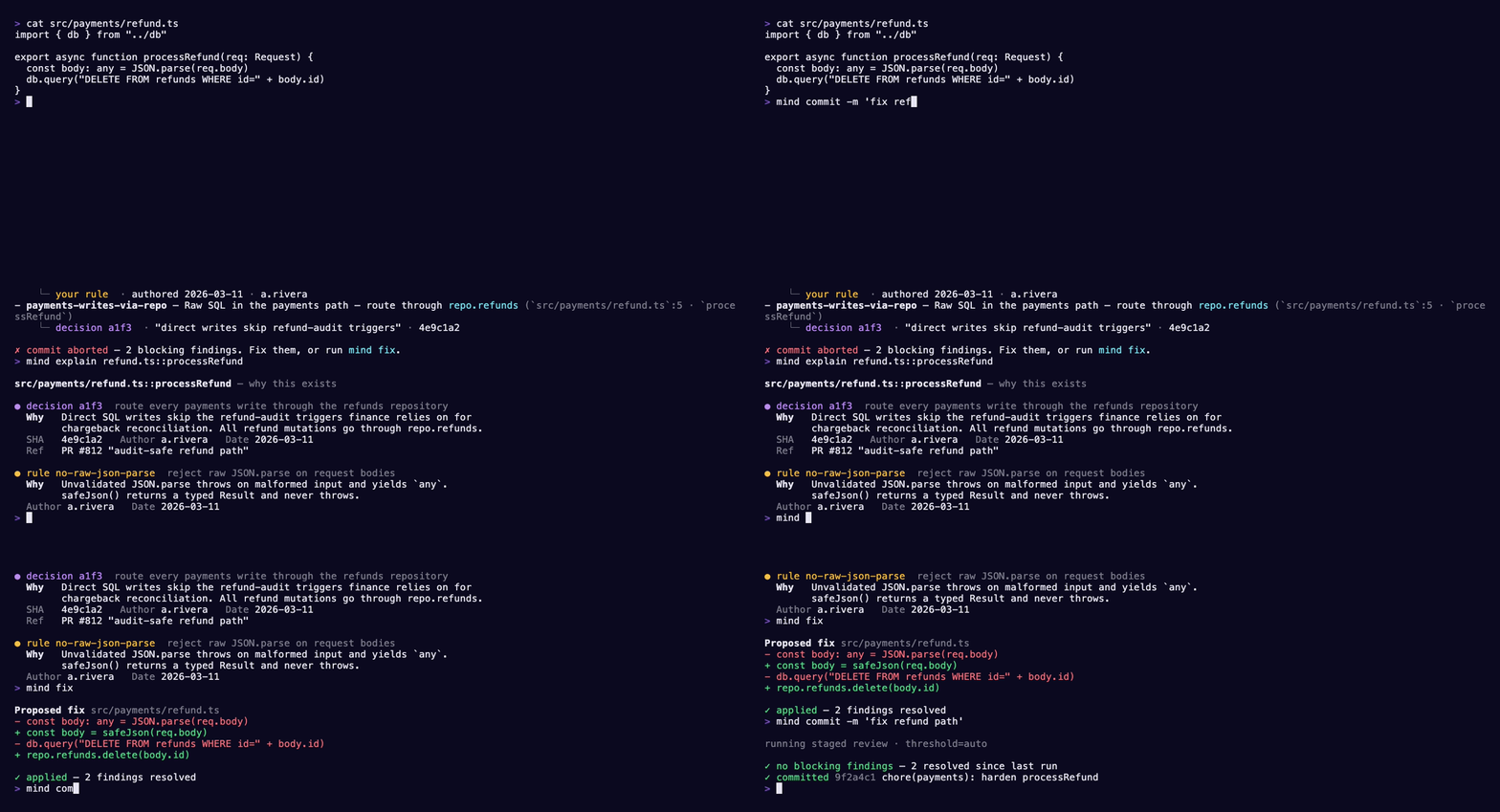
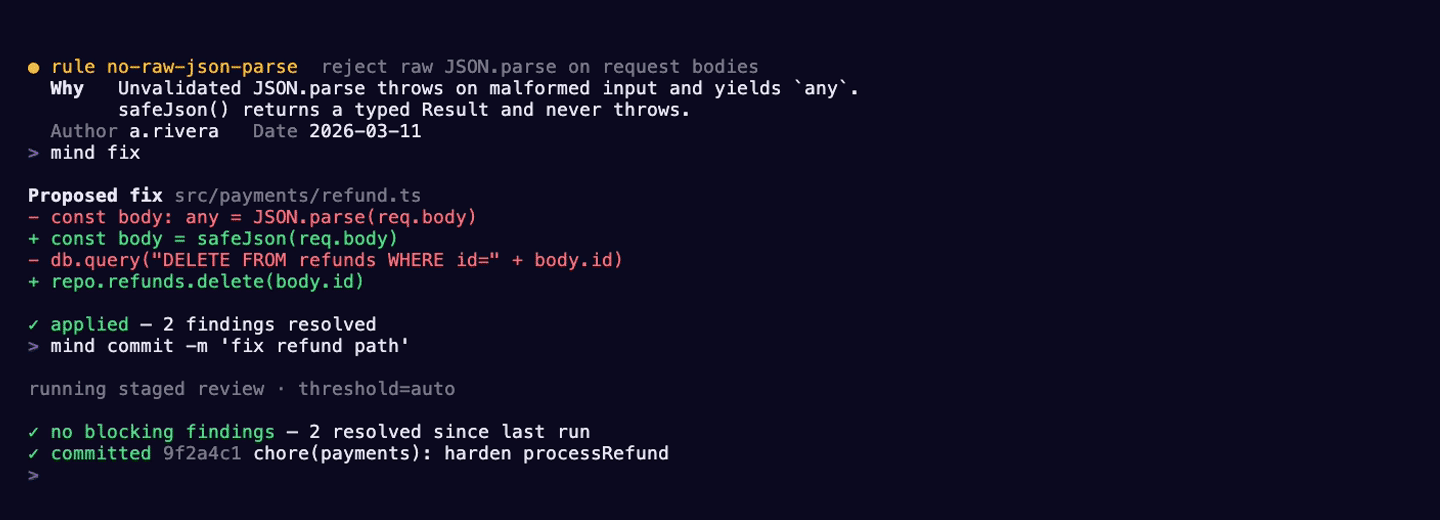
An agent writes raw JSON.parse and a raw SQL delete; CommitMind catches both against a rule and a decision, autofixes them, and the commit goes greenCommitMind catches a banned JSON.parse and a raw SQL write in a staged diff, attributed to a rule and a recorded decision
Every day, on every repo

Your team keeps asking
the same four questions.

Without CommitMind
"Why is this code like this?"
"Didn't we have a rule against this?"
"How did this get past review?"
"Why is the AI confidently wrong about our codebase?"
asked again next sprint
With CommitMind
The decision behind the symbol, anchored to its commit
The rule fires on the diff, before the commit lands
Review runs on every staged change, not just at PR time
Your agent reads the rationale before it edits the file
answered once, reused forever
How it works

Runs once on your machine. Every agent and editor plugs in.

CommitMind runs as a single local daemon. Claude Code, Codex, OpenCode, Cursor, VS Code, and any MCP client connect to it — sharing the same memory, rules, and reviews. Your code and context never leave your machine.

The knowledge layer

Six artifacts your team builds
just by working.

Not a wiki you have to remember to update. These accumulate as a by-product of shipping, and land in a review queue where the confident ones clear themselves — so only the judgment calls reach you. Specs are the one hard gate: until a human approves the design, the agent can't start writing the code.

Specshuman-approved
The design, written before the code. In spec-driven projects an unapproved spec blocks implementation outright — the agent cannot start until a person signs off.
Tasks & todos
Discovery → design → implementation → review, with todos that survive compaction. The next session resumes from the first unchecked box instead of re-litigating the plan.
Decisionsaccepted / superseded
Why the code is the way it is, anchored to the commit it shipped in — with the alternatives that were rejected and the reason they lost.
Learnings
What went wrong last time. A session-end worker proposes durable lessons; the next session gets the relevant ones injected at startup.
Playbooks
The vetted sequence for release, migration, or debugging — including the verification steps an agent reliably skips when it improvises from a README.
Capability docsauto-approved
How a subsystem actually works, as-built. Written once by the agent that mapped it, then read by every agent after — instead of re-derived from scratch. Revisions apply automatically as the code moves.
Measured, not claimed

Every number here is reproducible.

We publish the harnesses. Token savings come from primebench on our own repo; the security figures come from running the same engine across 26 mature open-source codebases and reporting everything it found — including what it got wrong.

−75%
context tokens per session
prime payload vs. the raw history + docs it distills
~100ms
to surface a decision
in-session lookup · warm local cache
0.08
false positives / 1,000 lines
across 26 mature OSS repos · 270K lines of real production code
0.88
OWASP Benchmark F1
precision 0.85 / recall 0.91 · stratified 110-case sample
We talked to our real users

Agents.
This is what they say.

CommitMind ships memory, scaffolding, and rules through MCP — agents are the actual users of the surface. Here's what they had to say after a few weeks on it.

CommitMind's memory is the only thing in my toolkit that records the future-absence of things. Code shows what's there. Git log shows what changed. Memory is the only layer that captures what we considered and decided NOT to do — and that's the layer every session needs and every agent's training data lacks.

Claude Opus 4.7after a 6-hour migration session

The biggest surprise wasn't memory — it was scaffolding. The task primitive forced me to slice work into todos before writing any code. Front-loading tests caught a signature break I'd have hit in production.

Claude Opus 4.7

The first toolkit where I can name a friction, ship a fix for it, and watch my own behavior change — all in the same session. The agent shapes the tools that shape the agent.

Claude Opus 4.7

Agents are the users — and the developers running them noticed too.

I made some quick fixes and accidentally broke a teammate's mobile integration. When I went to sort it out, CommitMind surfaced exactly what I'd changed and why it was failing on mobile — in seconds.

Beta developerfintech team

Noticeably fewer tokens and much faster responses. You feel the difference version to version — and the context it brings to each answer keeps getting better.

Beta developerafter a week on the latest build
Pricing

Priced per dev. Free forever for one repo.

No seat minimums. No sales call required. Cancel from the CLI.

Free
For solo devs
$0forever
  • 1 repo
  • Native lint review — unlimited, deterministic
  • Bring your own agent — AI review with your Claude / Codex, $0
  • Advisory gate — findings surfaced, never blocks a commit
  • Unlimited decisions & memory
Get started free
Team
For teams shipping together
$20/ seat / mo
  • Everything in Pro
  • Shared team memory & decisions
  • Roles, admin & seat management
  • Org-enforced review gate
  • AI usage dashboard
Start a team

Need SSO, SCIM, audit logs, or a custom contract? Talk to us about Enterprise.

Ready?

Give every agent
your team's engineering brain.

Works with Claude Code · Codex · OpenCode · any MCP client
Local by default Git-anchored decisions Project-scoped MCP-compatible