Every staged diff, checked against your rules and decisions
Each finding carries its source — your rule, or the decision it traces back to. Tight enough to leave on: no false-positive noise.
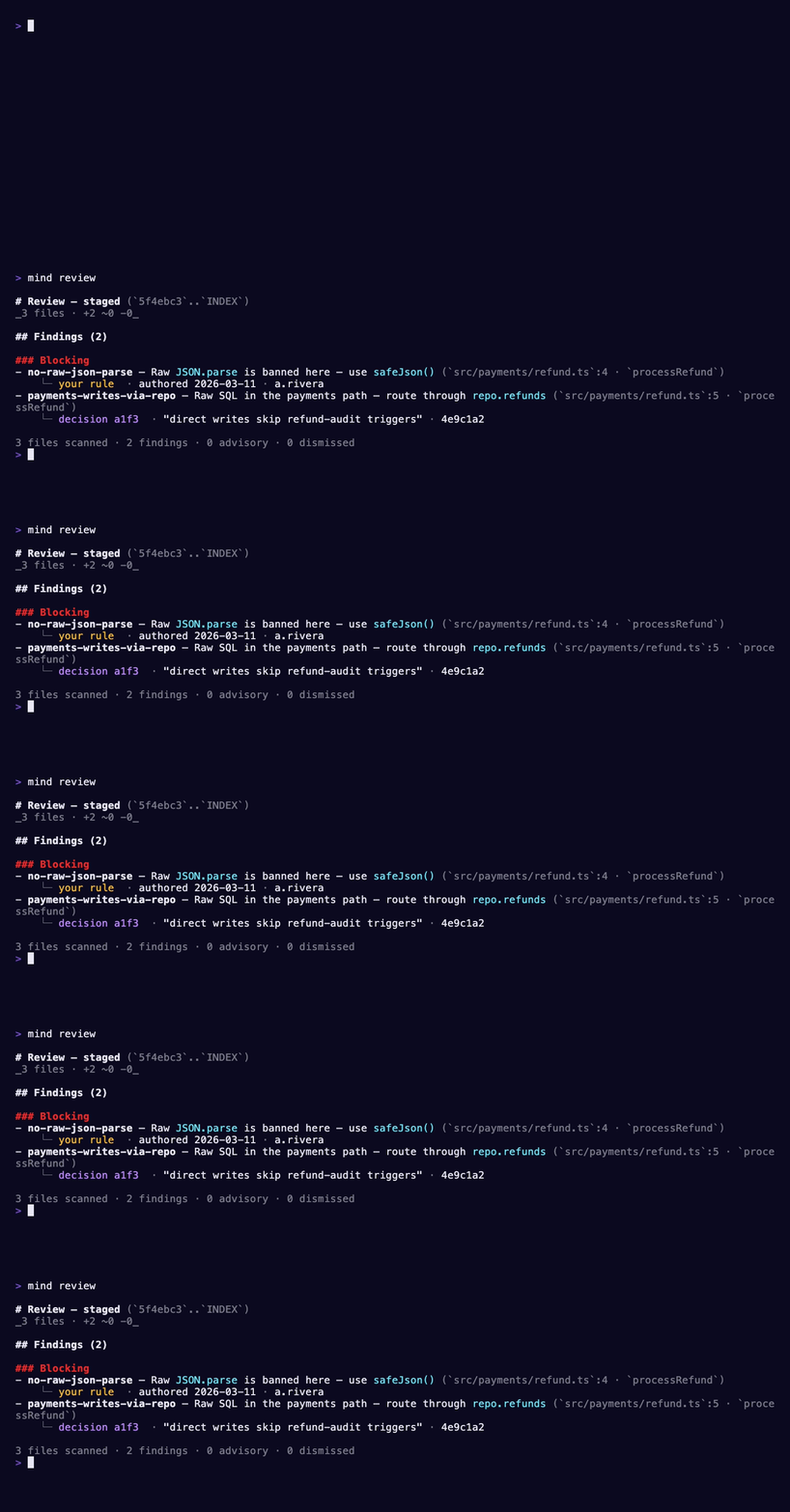
Catch the bug before the commit,
not in production.
commitmind review and the pre-commit gate read your diff in-session — deterministic rules plus a two-pass AI reviewer, security and correctness, flag real bugs, injection, banned APIs, and the decisions you're about to break before the code lands. Every candidate is adversarially refuted before it surfaces — signal, not noise. Each finding makes the next diff cleaner.
From one staged diff
to the whole codebase.
The same deterministic engine runs at the pre-commit gate and across every file — the OWASP/GOSEC security pack flags real vulnerabilities with interprocedural taint, not regex guesses.
Quiet enough to leave on.
We don't just score against the OWASP Benchmark (F1 0.88, precision 0.85 / recall 0.91) — we run the same engine across 26 mature OSS codebases, 270K lines of real production code, and publish what it finds: just 0.08 false-positives per 1,000 lines, with 111 real known-CVE dependency advisories surfaced as a separate bucket. Signal, not noise.
● full · ◆ AI-pack extended · ○ partial. Deterministic static analysis flags what code can prove — deepest on Go (SSA-based taint), seven languages. AI soft-rule packs reach into the classes static can't fully model: dropped authorization guards, IDOR and mass-assignment (A01), missing rate limits on sensitive routes (A04), unsafe deserialization (A08). A pack rule only gatesonce it clears a precision/recall bar on a curated corpus — until then it's advisory, never a spurious block. We still say where it stops: missing MFA and brute-force gaps need runtime.
AI packs validated on a curated corpus spanning four frameworks — OWASP Top-10, HIPAA, PCI-DSS and SOC 2 — 194 cases across nine languages, regenerated on every eval run. Each rule gates only above its precision/recall bar; the rest stay advisory. See the compliance breakdown below.
Maintainability: E.
So which of the 20 issues do I fix?
That is a real quality gate failing on a real repository, and it is unactionable by construction: the letter is a debt ratio built from remediation estimates the tool guessed at. CommitMind leads with the condition that actually blocks a commit — and shows nothing it cannot source.
There is no A–E rating here, on purpose. That grade is a ratio of remediation effort to development cost, and the effort half comes from per-rule time estimates. We hold no such data, so publishing a letter would mean inventing one and borrowing a name buyers already trust. It is about an hour of work — which is precisely why it would have shipped without anyone deciding it should.
“New” and “resolved” are counted over a trailing window across the whole ledger, not per scan — a per-scan delta reads zero on a quiet afternoon while the week added findings. A repository that has never completed a scan renders as not scanned, never as a green gate over an empty ledger. Figures above are CommitMind’s own repository, read off the shipped panel.
We never run your tests. Coverage is parsed from a report your project already produces, because a tool that executes an arbitrary suite on a background loop — spawning containers, hitting databases, costing money — is a tool people uninstall. The cost is honest: with no report, the panel says not measured and never 0%. An unmeasured repository and an untested one are different claims, and we will not render them the same. The figure is stated in statements for the same reason — Go counts statements and LCOV counts lines, so a bare percentage would invite comparing two numbers that never measured the same thing.
Your AI just shipped a HIPAA violation.
Your linter said nothing.
Generated code drops an authorization guard, logs a card number, sends PHI over plaintext — all valid syntax, all invisible to a linter. CommitMind is the review that gates the commit on HIPAA, PCI, and SOC 2, and proves it with precision and recall — not a logo wall.
194 hand-curated cases across 4 frameworks and 9 languages — each a real violation next to its look-alike safe carve-out. Overall precision 0.99 / recall 0.98, regenerated on every eval run from a committed harness.
A rule gates only once it clears the bar (precision ≥0.85, recall ≥0.50, ≥6 cases); below it, it surfaces but never blocks. We publish what it still gets wrong: a mass-assignment carve-out still false-flags (0.75 precision — so it stays advisory, never a spurious block), and SOC 2 audit-logging recall sits at the gating floor on borderline failed-login diffs. Ruby, PHP, Kotlin and Rust are spot-checked, not yet validated at the depth of Python, JS, Go, Java and C#.